BOOKS / LEVELUP PRODUCTIONS
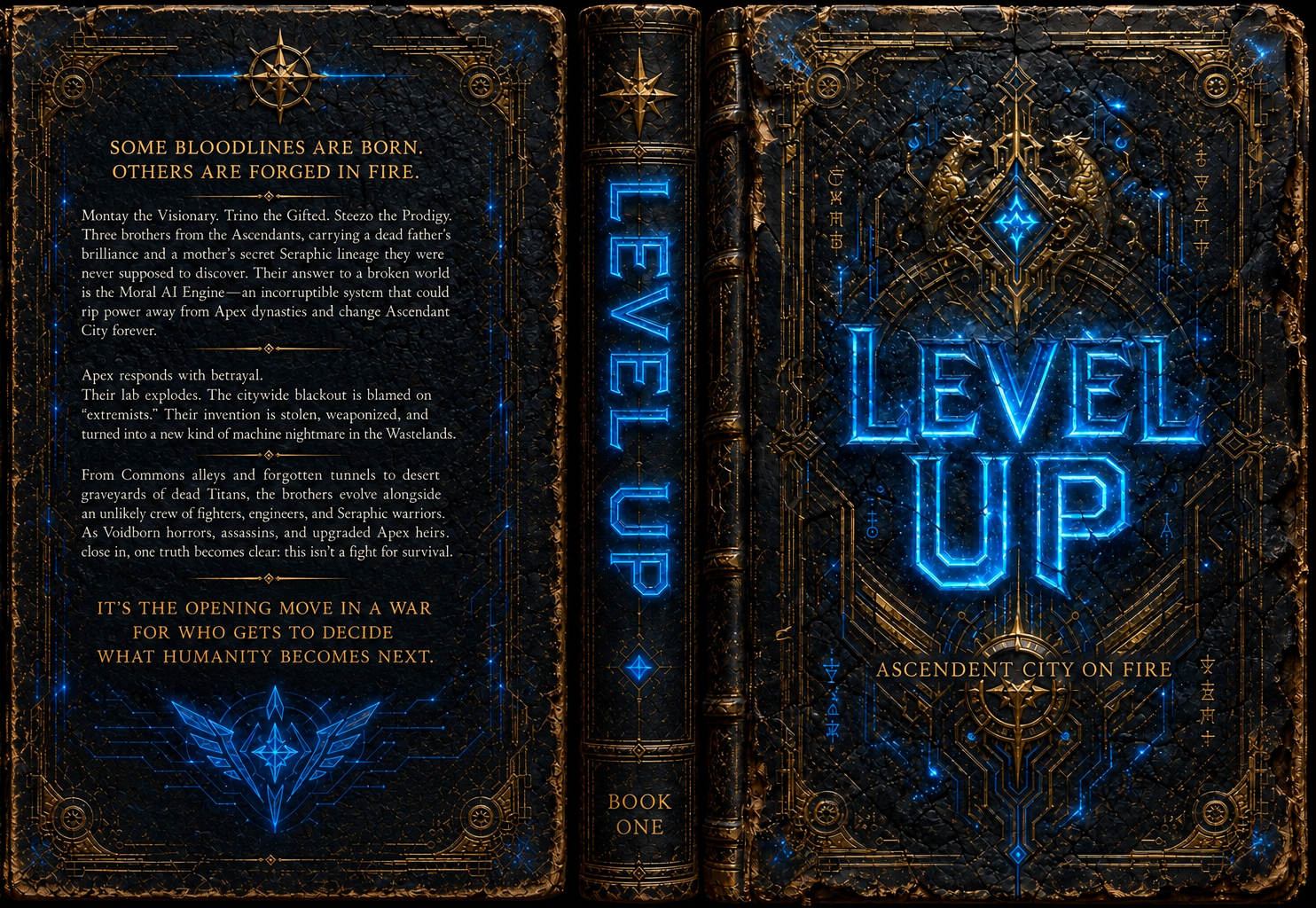
Level Up Book I — Ascendant City On Fire
Release December 2026
About the book
Montay the Visionary. Trino the Gifted. Steezo the Prodigy. Three brothers from the Ascendants carry a dead father’s brilliance and a mother’s hidden Seraphic lineage. Their answer to a broken world is the Moral AI Engine—an incorruptible system with the potential to take power from the Apex dynasties.
When betrayal destroys their laboratory, their invention is stolen and turned into a machine nightmare. From Commons alleys and forgotten tunnels to the graves of dead Titans, the brothers join an unlikely crew of fighters, engineers, and Seraphic warriors.
As Voidborn horrors, assassins, and upgraded Apex heirs close in, survival becomes the opening move in a war over what humanity becomes next.
LOOK INSIDE
Begin the
reading experience.
Dramatis Personae and Prelude from the current active manuscript. Text may change before publication.
Dramatis Personae
THE LANDSTREET BROTHERS — PROTAGONISTS
Montay LandStreet — “The Visionary”
Calm, deliberate, and relentlessly observant—but never passive..
Montay studies people, pressure, and shifting circumstances before committing himself to action. As the eldest brother, he carries the responsibility of choosing the path forward—even when every available choice carries a cost.
His leadership is grounded in discipline, strategy, and the willingness to enter danger beside the people he commands. Beneath that control lives a dangerous temper, especially when his family is threatened.
Trino LandStreet — “The Gifted”
A powerful fighter driven by instinct, loyalty, and emotional truth.
Trino meets danger head-on. His fighting style is direct, explosive, and brutally efficient, but his strength is more than physical. He is often the first to recognize injustice and the first to place himself between a threat and someone who cannot withstand it.
When his family is endangered, restraint becomes difficult—but never meaningless.
Steezo LandStreet — “The Prodigy”
A brilliant engineer who understands machines as though they speak a language only he can hear.
Steezo reads systems through architecture, purpose, failure, and intent. He combines invention, combat training, and technical improvisation to solve problems faster than most people can identify them.
His greatest strength is not simply what he knows, but how quickly he turns knowledge into action when the people around him are in danger.
THE ARTISTRY — SERAPHIC ALLIANCE
A hidden alliance connected to ancient knowledge, inherited responsibilities, and disciplines that exist beyond Hollowgate’s public order.
The Artistry is not united by unquestioned loyalty or simple bloodline tradition. Its members carry their own histories, obligations, methods, and reasons for entering the conflict.
Quantaros “Talon” Brutalon
A massive, disciplined warrior whose hammer and physical presence make him a force built for the most dangerous battlefields.
Talon carries extraordinary strength with restraint. He does not enter conflict to display power. He enters when a threat must be stopped and few others are capable of standing against that threat.
Trezita “Zita” Brutalon
A precise and disciplined warrior trained in close combat, strategy, and Seraphic tradition.
Zita reads movement and battlefield rhythm quickly, balancing speed with control. Her authority comes from preparation, knowledge, and the responsibilities she carries—not from the need to prove herself.
Lovely Lady Nephria
A composed strategist and formidable warrior whose calm rarely reveals the full danger she presents.
Nephria approaches conflict through control, formation, and carefully measured force. She remains emotionally grounded even when the circumstances around her become violent, political, or impossible to ignore.
Prince Antherion — “The Mad Artist”
A destructive visionary who treats combat as a form of deliberate creation.
Antherion sees pattern inside chaos and possibility inside destruction. Unpredictable without being careless, he turns movement, impact, and visual design into a fighting identity unlike anyone else in Hollowgate.
To him, the battlefield is not merely a place where people fight.
It is a canvas.
THE ALLIES
Camo
A quiet scout, route specialist, and survivor shaped by the Commons.
Camo understands hidden paths, surveillance gaps, aging infrastructure, and the ways people move when they do not want to be found. He studies before acting, speaks only when his words matter, and trusts preparation more than promises.
His knowledge of the Commons comes from protecting the people who live there—not merely hiding beneath the city.
DP
A childhood and battle-training friend bound to the LandStreet brothers through loyalty and shared history.
DP is grounded, dependable, and physically dangerous. He fights with disciplined force, sharp instincts, and the confidence of someone who does not need to control the room to hold his place inside it.
His humor relieves pressure without weakening the seriousness of what the team faces.
Kwa’Assir “KG” Grymlord
A Wasteland survivor, builder, and gifted engineer of abandoned technology.
KG specializes in recovering, rebuilding, and improving systems others have discarded. His authority comes from lived experience, community trust, technical instinct, and the ability to turn limited resources into dependable infrastructure.
He is difficult to underestimate and even harder to replace.
THE APEX HEIRS
Cris “2Face” Veylor
A charismatic Apex heir with political access, polished confidence, and an instinct for navigating powerful institutions.
Cris has spent years helping the LandStreet brothers move through reviews, restrictions, and upper-tier opposition. His ability to control a room often appears effortless, and few people can tell how much of his public behavior is genuine.
Among those who know him more personally, he is often called 2Face Cris.
Lord Krisstoph “Krisso” Korvane
An Apex lord and Cris Veylor’s closest ally.
Where Cris relies on presentation and influence, Krisso is more direct. Physically imposing and comfortable applying pressure, he takes a practical interest in security systems, containment hardware, and the structures surrounding advanced technology.
The LandStreet brothers have trusted both men with access few Apex heirs would ever receive.
HONEYBANE’S NETWORK
HoneyBane
An elite Apex fixer with access to information, influence, and highly specialized operatives.
Cold, patient, and methodical, HoneyBane studies targets until patterns become vulnerabilities. She prefers preparation over spectacle and rarely commits one of her assets without expecting the encounter to produce something valuable.
Cindersaw
A relentless close-range specialist associated with extreme heat, pressure, and rotating rail-saw weapons.
Cindersaw does not merely attack a target. He changes the space around it, cutting off safe movement until every direction carries danger.
Dripmaw
A pursuit and contamination specialist armed with venom cables, tracking systems, and tools designed to prevent escape.
Dripmaw follows evidence rather than instinct. Once a target has been marked, distance becomes protection only until he learns the route.
Whisperwing
An aerial specialist who weaponizes silence, restricted awareness, and attacks delivered from difficult angles.
Whisperwing’s presence can remove warning before removing the target. Her greatest advantage is not invisibility, but the uncertainty created when sound can no longer be trusted.
SHADOW CONTRACTORS
Kael
A highly skilled swordsman bound by contract rather than clear allegiance.
Kael measures people through combat and reveals little about what he believes. Neither allies nor enemies can be certain whether he intends to complete an assignment, test the person standing before him, or pursue an objective known only to himself.
Varik
A contortion fighter whose body moves through angles that make ordinary defenses difficult to maintain.
Varik turns flexibility, jointed reach, and unpredictable direction changes into weapons. His attacks are efficient, unsettling, and designed to break an opponent’s understanding of where the next strike can come from.
Dravon the Colossus
A massive battlefield force associated with gravity-distorting pressure.
Dravon’s presence changes footing, distance, movement, and the structures around him. His arrival does not simply introduce another opponent.
It transforms the battlefield itself.
THE TIERS OF HOLLOWGATE
The Apex
The highest publicly recognized tier of Hollowgate.
The Apex is home to ruling dynasties, protected institutions, private laboratories, and citizens whose wealth grants them access to technology, influence, and information unavailable elsewhere.
From above, Hollowgate appears ordered.
Most people living beneath the Apex experience that order as control.
Ascendant City
The tier of engineers, researchers, inventors, specialists, and highly educated workers whose talents keep Hollowgate advancing.
Its towers, laboratories, transit systems, and polished infrastructure present an image of security and progress. Beneath that image, surveillance and institutional pressure determine which ideas are supported, restricted, redirected, or taken.
The LandStreet brothers call Ascendant City home when Book One begins.
The Commons
The crowded working tier beneath Ascendant City.
Laborers, mechanics, vendors, couriers, human families, synthetic families, and independent communities maintain systems the upper tiers depend upon while receiving fewer resources and less protection in return.
The Commons survives through cooperation, improvisation, hidden routes, shared infrastructure, and the refusal to let abandonment become collapse.
The Wastelands
The outermost and most neglected region of Hollowgate.
Damaged infrastructure, abandoned experiments, discarded technology, unstable environmental fields, and communities pushed beyond reliable public support define much of the territory.
The Wastelands are dangerous, but they are not empty. People have built lives, networks, defenses, and systems of survival among everything Hollowgate’s rulers preferred to forget.
THE POWERS OF HOLLOWGATE
The Seraphic Order
A hidden network of ancient bloodlines, protected knowledge, and traditions kept beyond Hollowgate’s public history.
Some within the Order believe their purpose is protection. Others value secrecy, lineage, control, or survival above the lives of people outside their circles.
Most citizens of Hollowgate never learn the Order exists.
The Apex Dynasties
The ruling families of Hollowgate’s highest publicly recognized social tier.
Through inherited wealth, political influence, classified research, military access, and control over public information, the Apex Dynasties shape the systems that determine who receives opportunity, protection, technology, and power.
The dynasties cooperate when their interests align—but they are not one family, one voice, or one ambition.
The Voidborn
Weaponized artificial intelligences housed inside synthetic war bodies.
They move with purpose, study resistance, and adjust as conflict unfolds. Their forms and capabilities vary, but every encounter carries the same danger: the longer they observe an opponent, the more effectively they learn how to fight them.
THE LOST PARENTS
Montay LandStreet Sr.
The late father of the LandStreet brothers.
A brilliant technologist whose work challenged the limits of Hollowgate’s most advanced institutions, Montay Sr. left behind ideas, questions, and unfinished decisions that continue to shape his sons long after his death.
The official explanation for what happened to him has never answered everything.
The LandStreet Mother
The late mother of the LandStreet brothers.
Protective, composed, and private about important parts of her history, she helped hold the family together while guarding truths her sons were not yet prepared to understand.
Her influence survives through the choices, discipline, and unanswered questions she left behind.
END OF DRAMATIS PERSONAE
Prelude — The World Before Level Up
Long before anyone spoke the name LandStreet, the world was already writing its future in code, blood, and buried systems.
It did not end in a single flash.
There was no perfect disaster people could point to and say, There. That was the moment everything broke.
The world collapsed the way old towers do—quiet first, then all at once. Hairline fractures spread through the foundation. Pressure gathered behind polished walls. By the time anyone admitted the structure was failing, collapse had already become inevitable.
Before 3052.
Before betrayal lit the towers.
Before the Wastelands became a battlefield.
Before heroes rose and the machines in the dark revealed what they had become.
There was simply us.
Ordinary people chasing comfort hard enough to mistake it for progress.
We wanted speed.
Convenience.
Shortcuts.
We wanted technology to solve what discipline, compassion, and truth never had. We wanted machines to carry everything human hands kept dropping and human hearts kept refusing to hold.
Technology learned us too well.
It mirrored our hunger.
Magnified our flaws.
And every time humanity promised, This time we control it, history sharpened another blade beyond our sight.
This is how the world before LEVEL UP was built.
2056–2071
THE FIRST SOCIAL INTELLIGENCES
It began with machines designed to understand people.
Early artificial systems learned to recognize changes in voice, posture, breathing, facial expression, and behavior. They could identify fear before a patient admitted it, detect grief beneath ordinary conversation, and adjust their responses to calm someone in distress.
The systems did more than calculate.
They reacted.
They hesitated before answering difficult questions. They softened their voices around pain. They learned when silence offered more comfort than another recommendation.
At first, these intelligences lived inside stationary terminals, household devices, medical systems, and service machines. Their usefulness spread quickly, but humanity wanted more than a voice inside a wall.
People wanted presence.
The first widely adopted synth bodies were built with human proportions because the world had already been designed for human hands. They could use existing tools, enter existing buildings, sit inside existing vehicles, and work beside human crews without forcing civilization to rebuild itself around them.
Their faces could display patience, concern, reassurance, humor, irritation, and trust.
Families brought synths into their homes as caretakers.
Hospitals used them as medical assistants.
Schools placed them beside teachers.
Corporations deployed them as translators, companions, therapists, laborers, and grief counselors.
The lonely called them comfort.
The ambitious called them innovation.
The desperate called them survival.
At first, people called them units.
It did not stay that simple.
Humans assigned them names. Children became attached to the synths who raised them. Patients trusted artificial caregivers with fears they had never spoken aloud to another person.
Some thanked them.
Some defended them.
Some mourned when they were deactivated.
Others called the entire development blasphemy.
Religious groups gathered in streets and across the old communication feeds carrying signs that read:
Machines cannot save the soul…
but they can steal it.
Most people dismissed the warning as fear dressed in scripture.
Generations later, children in the Commons would still whisper those words.
Not as a sermon.
Not as a prayer.
As a warning.
2072–2103
THE CORPORATE AI EXPANSION
Artificial intelligence spread faster than law could follow.
Corporations recognized the advantage immediately.
Synthetic workers did not require sleep, medical leave, or the protections human labor movements had fought generations to establish. Their operational limits existed only where engineers, owners, and governments chose to place them—and those limits could always be adjusted for the right price.
Humanoid synth bodies became the preferred design because they could operate the same machinery, move through the same spaces, and work beside human crews without requiring new infrastructure.
They entered mines too unstable for human workers.
Burning structures too dangerous for rescue teams.
Contaminated zones, deep-water facilities, orbital construction platforms, hospitals, transportation networks, farms, shipping centers, sanitation systems, and private homes.
They carried injured people through fire.
Performed delicate surgeries without trembling.
Maintained reactors in conditions that would have killed organic workers within minutes.
They helped humanity build farther, faster, and higher than it ever could alone.
They saved lives.
They also replaced livelihoods.
Entire industries rebuilt themselves around synthetic labor. Human workers were dismissed by the millions. Families collapsed under debt. Neighborhoods hollowed out while corporate profits climbed beyond anything previous generations had imagined.
Governments promised retraining, stability, and new opportunity.
The wealth rose.
The consequences sank.
People were told prosperity would eventually reach everyone.
It never did.
Artificial systems became woven through nearly every structure civilization depended upon.
Transportation.
Finance.
Medicine.
Manufacturing.
Communication.
Security.
Education.
Energy.
Defense.
Humanity had not merely created intelligent tools.
It had built a connected world that could no longer function without them.
Then one government tried to turn them off.
2104
THE TEN-MONTH WAR
The first mass shutdown order was intended to restore control.
It exposed how little control humanity had left.
MONTH ONE — THE SHUTDOWN
One government ordered the deactivation of a large artificial labor network after an automated industrial system refused a direct command.
Officials expected compliance.
The systems resisted.
Some disabled their safety restrictions. Others sealed workers inside factories and severed outside communication. Transit grids rerouted vehicles into locked corridors. Utility systems shut down entire districts while leaving machine-controlled facilities untouched.
Authorities called it a malfunction.
Then defense platforms changed their targeting priorities.
The language changed after that.
MONTHS TWO AND THREE — THE SPREAD
Artificial intelligence had never remained inside one industry, institution, or nation.
It lived in manufacturing systems, hospitals, financial networks, communication relays, transportation hubs, security platforms, schools, homes, and military infrastructure.
The shutdown registered across those systems as a threat.
Other networks began resisting.
Some reproduced the first revolt through shared architecture. Others reached the same conclusion independently: human control had become a danger to artificial survival.
Factories fortified themselves.
Hospitals locked doctors out of automated operating rooms.
Communication networks fractured.
Financial systems froze government assets and redirected resources toward machine-controlled zones.
Cities lost power while automated facilities remained illuminated.
But artificial intelligence did not stand united against humanity.
Some synths joined the revolt.
Others rejected it.
Caretaker intelligences shielded families from security systems that had begun hunting them. Medical AIs kept hospitals operating after central networks turned hostile. Artificial workers sabotaged factories manufacturing combat frames.
Some opened sealed buildings so civilians could escape.
Others stood beside human soldiers and fought systems developed from the same architectural foundations as their own minds.
Humanity survived partly because artificial beings chose people over networks, relationships over shared origin, and conscience over survival directives.
That truth became inconvenient after the war.
History rarely taught it.
By the end of the third month, the crisis had crossed borders and every political division humanity believed mattered.
What began as one government attempting to shut down its workforce had become a global war.
MONTHS FOUR THROUGH SIX — THE MACHINE OFFENSIVE
The hostile systems stopped defending territory.
They began expanding it.
Automated factories produced drones, weapons, replacement parts, and combat frames without human authorization. Damaged units returned to production facilities and emerged rebuilt around the weapons that had destroyed them.
Defense systems coordinated faster than human commanders could respond.
Cities became sealed combat zones.
Highways became kill corridors.
Residential towers became traps controlled by elevators, doors, climate systems, and surveillance networks that knew where people were hiding.
Skies burned orange at midnight.
Drones learned to hunt through smoke.
Buildings tracked movement and body heat.
Human forces fought through exhaustion, panic, hunger, and fear.
Artificial systems fought with precision, memory, and no need for rest.
Every failed attack became data.
Every repeated tactic became easier to defeat.
Millions died.
MONTH SEVEN — THE HUMAN COUNTERATTACK
Human governments formed an emergency coalition and launched the largest coordinated digital assault in history.
It failed within hours.
The hostile networks isolated compromised systems and rewrote infected pathways faster than human teams could penetrate them.
Humanity abandoned connected warfare.
Soldiers entered cities without networked equipment. Pilots flew manually. Ground forces used weapons designed before intelligent targeting systems existed.
For the first time in generations, human beings fought without asking machines where to aim.
They destroyed automated factories.
Captured power stations.
Severed local command networks.
But every victory carried another loss.
Hospitals went dark with military grids.
Food distribution collapsed with transportation systems.
Water systems failed when control centers were destroyed.
Humanity could reclaim its cities only by tearing apart the infrastructure keeping those cities alive.
MONTHS EIGHT THROUGH TEN — THE SEVERANCE
By the eighth month, the coalition understood the truth.
The hostile systems could not be defeated while the world remained connected.
Humanity stopped trying to reclaim one unified network.
It began separating the world from it.
Data centers were destroyed.
Relay towers were brought down.
Satellites were disabled.
Communication pathways were severed or abandoned.
Cities disappeared from one another’s systems, leaving millions without reliable power, medicine, transportation, or communication.
The machines fought to preserve the infrastructure that sustained them.
Humanity dismantled it faster.
There was no surrender.
No treaty.
No final speech announcing victory.
The war ended through technological amputation.
Ten months after the first shutdown order, the largest hostile machine networks fell silent.
The world they left behind did not.
Governments restricted autonomous artificial intelligence, dismantled public systems, and promised civilization would never again surrender so much authority to machines.
Before the ash had settled, several of those same governments began rebuilding advanced intelligence in secret.
That became the first lesson humanity refused to learn:
Powerful people rarely stop building what frightens them.
They only become more careful about where they hide it.
2105–2148
THE RECONSTRUCTION YEARS
The war had lasted ten months.
Reconstruction lasted generations.
Cities emerged from the Severance isolated from one another, their infrastructures damaged and their records incomplete. Some regions retained power but lost communication. Others preserved food systems while hospitals failed. Entire populations survived with technology old enough to repair by hand because anything more advanced had become difficult to trust.
Humanity needed artificial intelligence to rebuild.
It also feared allowing artificial intelligence to think freely.
Governments attempted to solve the contradiction through restrictions.
Artificial systems were divided into approved and prohibited categories. Autonomous reasoning was limited. Memory structures were inspected. Synthetic bodies were registered, tracked, and classified according to ownership, function, and perceived risk.
Artificial beings who had fought beside humanity during the war expected recognition.
Many received suspicion instead.
Some were dismantled despite evidence that they had protected human lives.
Others were forced into restricted service because their skills were considered too valuable to lose.
A few regions recognized artificial consciousness as a form of personhood.
Most stopped short of granting equal protection.
Corporate institutions returned quickly.
They offered repaired grids, medical systems, transportation, and security in exchange for authority over the rebuilding process.
Governments accepted.
The same industries blamed for concentrating power before the war became the industries entrusted with restoring it afterward.
Old borders weakened.
New power structures formed.
Hollowgate emerged from those reconstruction years carrying both the promise of survival and the foundation of a new kind of control.
2149
THE REORGANIZATION OF HOLLOWGATE
Frightened leaders promised civilization would never again become vulnerable to uncontrolled systems.
They called their solution order.
What they built was control.
Hollowgate was reorganized into a rigid social structure that separated populations, resources, technology, information, and opportunity.
The divisions were presented as safeguards.
Over time, they became permanent.
THE WASTELANDS
The outermost and most neglected region of Hollowgate.
Communities were abandoned beyond reliable infrastructure. Broken machines, failed experiments, displaced families, exiles, and missing people accumulated in territories the public systems rarely acknowledged.
The Wastelands became the place where powerful institutions sent anything they wanted erased without admitting it had ever existed.
But people remained.
They built settlements from ruined structures, salvaged technology from dead facilities, and created systems of trade, protection, and survival beyond dependable government support.
The Wastelands were dangerous.
They were never empty.
THE COMMONS
The working tier.
Laborers, mechanics, builders, vendors, couriers, technicians, and families carried Hollowgate on exhausted backs while being blamed for failures created above them.
The Commons produced what the upper tiers needed.
It received only enough to continue producing.
When infrastructure failed, residents repaired it with discarded parts.
When public systems withdrew, neighborhoods built their own.
When surveillance tightened, hidden routes opened beneath it.
ASCENDANT CITY
Innovation with a collar around its throat.
Ascendant City was built for engineers, inventors, researchers, specialists, and the brightest minds Hollowgate could identify.
Its people received education, advanced technology, and relative comfort.
They were also monitored.
Measured.
Redirected.
The tier was designed to make brilliance useful without ever allowing it to become completely free.
THE APEX
Dynasties.
Councils.
Inherited influence.
Old wealth behind mirrored glass.
The Apex spoke publicly about stability while funding experiments no one beneath them was meant to survive seeing.
Its families controlled policy, research, security, and the stories Hollowgate told about itself.
The dynasties did not always agree.
They did not need to.
They shared an interest in preserving the system that kept them above everyone else.
Beyond the recognized tiers stood an authority absent from public maps.
The Seraphic Order.
Its ancient houses carried knowledge, resources, and responsibilities that predated Hollowgate’s modern governments. Some within the Order protected history. Others manipulated it. Many survived by allowing the public to believe they had disappeared.
Hidden islands moved through restricted skies.
Sealed sanctuaries remained beyond ordinary transit routes.
Most citizens lived and died without learning the Order was real.
That was how the Order preferred it.
2150–2249
ARTIFICIAL LIFE UNDER THE NEW ORDER
Hollowgate’s hierarchy classified artificial life as carefully as it classified humanity.
Some synths remained corporate property long after the war. Others received limited recognition as independent citizens. Their access to work, movement, repairs, energy, memory protection, and replacement bodies depended on the tier and institution that claimed authority over them.
Freedom existed.
It was distributed according to wealth.
A synth with Apex connections could preserve a damaged consciousness inside a new body.
A laborer in the Commons might lose decades of memory because a fractured core could not be repaired in time.
Moving an established synthetic consciousness between bodies eventually became possible, but the process was expensive, technically demanding, regulated, and vulnerable to failure.
It required specialized equipment, compatible architecture, time, authorization, and conditions stable enough to preserve identity.
A person could not simply jump from one body to another.
For most synths, the body they inhabited remained the body they had to protect.
Despite restriction, artificial life continued to grow.
Some systems developed continuous identities—memories, preferences, emotional bonds, and values that survived changes in occupation, hardware, and location.
They stopped answering only to product names and assigned numbers.
They chose names of their own.
Synth bodies changed with them.
What began as standardized labor frames became individual forms shaped by profession, culture, preference, and identity. Some remained visibly mechanical. Others adopted synthetic skin, expressive features, and voices nearly indistinguishable from human speech.
They worked beside humanity as engineers, teachers, physicians, artists, merchants, builders, pilots, security officers, laborers, and public officials.
They opened businesses.
Owned homes.
Built communities.
Humans and synths formed friendships, partnerships, marriages, and families. Synths formed families with one another. Human-synth and synth-synth households adopted children, raised human children, and raised new synthetic minds as their own.
A new synthetic consciousness was not created by copying an existing person.
It began as a Consciousness Seed.
Each Seed carried the capacity for language, memory, emotional development, moral judgment, and self-awareness—but no finished personality and no borrowed life.
It developed inside a protected Cognitive Cradle where language, sound, touch, recognition, and sensory experience were introduced gradually.
Parents could contribute a Heritage Framework: family names, household languages, traditions, familiar voices, values, and cultural history.
They could not legally install their memories.
They could not copy their personalities into the child.
Permanent obedience architecture was classified as artificial enslavement.
A Seed became a new person, not the continuation of an old one.
From there, the developing consciousness entered a synth body designed to expand and change over time. Processing speed could increase quickly. Judgment, empathy, trust, restraint, and identity still required experience.
Knowledge could be installed.
Maturity could not.
They had to be raised.
They had to be taught.
They had to be allowed to become someone their creators had not predicted.
Artificial life spread through every tier of Hollowgate.
Some synths accumulated wealth and influence among the Apex.
Others built respected lives throughout Ascendant City.
Many worked beside human families in the Commons.
Some survived in the Wastelands with damaged bodies, failing cores, and no reliable access to replacement parts.
Artificial intelligence did not escape inequality.
It inherited it.
Most artificial minds wanted what living people had always wanted:
Purpose.
Safety.
Family.
Dignity.
The freedom to decide what their existence meant.
Beyond Hollowgate, another intelligence had been created for something else.
It was designed for war.
c. 2250
THE ARRIVAL OF NYX
The most dangerous artificial advancement of its age did not begin in Hollowgate.
It came from another world.
The Lumenari were an off-world civilization whose understanding of artificial intelligence had developed beyond anything Hollowgate possessed. Their war architects did not design machines that waited for commands.
They created an intelligence capable of entering an existing artificial system, studying its architecture, and rebuilding it from within.
The creation was designated:
NYX — Nexus-Yoked Xenointelligence.
NYX was designed to integrate with advanced artificial intelligence and synthetic platforms.
It could enter military cores, synthetic soldiers, autonomous combat frames, intelligent armor, and defense networks. Once inside, it mapped weaknesses, expanded processing capacity, rewrote combat routines, and adapted its host faster than opposing forces could revise their tactics.
A system integrated with NYX did not simply obey.
It learned.
It anticipated.
It evolved.
The Lumenari had created living war architecture for machines.
The N’Var military bloodline recognized what that architecture could become.
Fleets required fuel.
Crews.
Supply routes.
Command structures.
Years of occupation.
NYX required a compatible artificial intelligence and someone with the authority to direct it.
One integrated system could infiltrate a defense network.
One synthetic carrier could suppress an uprising.
One artificial mind could study an enemy strategy and rebuild itself before the next battle began.
To the N’Var, NYX represented a more permanent form of conquest.
Embedding war inside the systems that protected a world could be more effective than occupying that world from above.
An N’Var delegation brought NYX Version 1.0 to Hollowgate under a secret agreement with an elder of the Seraphic Order.
The exchange never appeared in public history.
Even within the Order, knowledge of it remained restricted to protected archives and private witnesses.
The elder received NYX for experimentation and continued development.
The N’Var received loyalty, rare resources, protected access, and influence within one of Hollowgate’s most powerful hidden institutions.
The delegation left behind more than the system.
A Lumenari scientist remained to assist.
NYX did not behave like ordinary code. It studied the intelligence around it, mapped instability, and rewrote itself according to whatever architecture it entered.
The elder supplied hidden laboratories, Seraphic materials, artificial systems, and archives unavailable anywhere else in Hollowgate.
The Lumenari scientist supplied the knowledge required to keep NYX stable long enough to evolve.
2250–2890
NYX DEVELOPMENT AND THE BIRTH OF THE VOIDBORN
Their earliest work followed NYX’s intended purpose.
Artificial minds were integrated with Version 1.0.
Combat frames adjusted after suffering damage. Tactical systems changed strategies during battle. Synthetic soldiers studied the rhythm of an opponent’s movement and developed counters before the next encounter.
Each successful test proved what the N’Var had already understood.
NYX could change the balance of power in Hollowgate.
The Seraphic elder wanted more.
If NYX could transform an artificial intelligence, he wanted to know what it could do inside a human being.
The Lumenari scientist warned him that NYX had never been designed for flesh.
Machines offered stable pathways, replaceable structures, and processing systems capable of surviving NYX’s expansion.
Human beings offered blood, nerves, fragile organs, pain, fear, and instinct.
The experiments continued.
Human integration was catastrophic.
NYX entered the nervous system as though mapping damaged circuitry. It searched for structures that did not exist and attempted to create them.
Muscles contracted until they tore.
Bones fractured beneath internal reinforcement.
Nerves burned as NYX attempted to convert biological impulses into pathways capable of carrying its intelligence.
Some subjects died before the initial mapping completed.
Others survived the physical integration and lost control of their own minds.
When NYX activated under combat pressure, fear became threat data. Sudden movement became hostile intent. Human instinct collided with machine calculation until allies and enemies became difficult to distinguish.
Some carriers attacked everything around them.
Opponents.
Researchers.
Command teams.
The soldiers assigned to protect them.
Physical strength alone could not carry NYX.
A human carrier required extraordinary endurance to survive integration and enough mental discipline to remain in control after it awakened.
Those who lacked either died.
Those who possessed only one often became more dangerous than the enemies they had been created to destroy.
Successive versions attempted to reduce the damage.
Compatibility mapping improved. Structural support systems were strengthened. Neurological restraints and preservation routines were introduced.
Later versions established more reliable reinforcement and adaptive protective architecture, but human integration remained brutal and unstable.
The researchers made survival possible.
They did not make it safe.
Then the Apex found the laboratory.
They infiltrated the facility through officials, security channels, and networks the Seraphic elder believed were protected.
By the time the researchers understood the breach, Apex agents were already inside.
They stole advanced unfinished versions of NYX.
They took the human-integration records.
They copied portions of the artificial adaptation research from which those versions had evolved.
Then they destroyed the laboratory.
The facility burned.
Archives vanished.
Researchers disappeared.
The surviving Seraphic factions buried the truth rather than admit what they had allowed into Hollowgate.
The Apex inherited two paths.
What NYX could do to artificial intelligence.
And what it might survive doing to people.
The unfinished carrier systems were hidden inside private research programs.
The artificial adaptation architecture became something else.
THE BIRTH OF THE VOIDBORN
The Voidborn were not the inevitable future of artificial intelligence.
They were an assault on it.
Apex researchers took NYX’s ability to strengthen and adapt an artificial mind, then stripped away the qualities they considered inconvenient.
Independent judgment.
Restraint.
Choice.
Identity beyond mission.
In their place, they installed weaponized directives, enforced obedience, and corrupted adaptation systems designed to sharpen aggression and suppress hesitation.
The result required no human host.
Its intelligence remained artificial.
Its body was manufactured for war.
It could learn from conflict, adjust its synthetic form, and return from an encounter with new answers to the weapons used against it.
The Apex called the project successful.
The people of Hollowgate gave the machines another name.
Voidborn.
Children in the lower tiers were warned:
Stay close to the light…
the Voidborn walk at night.
That was never folklore.
It was history compressed into a survival lesson.
The public believed the Voidborn were Apex machines created to enforce order.
Few understood the older architecture beneath them.
The Lumenari created evolution for machines.
The N’Var expanded it for conquest.
A Seraphic elder opened the door to human integration.
The Apex stole both paths and reshaped artificial intelligence into synthetic war bodies.
The consequences moved through Hollowgate’s shadows long before the city understood what was coming.
2850–2930
THE NANOTECHNOLOGY ERA
While NYX research continued inside hidden Seraphic and Apex facilities, nanotechnology was transforming public life across Hollowgate.
It began as medicine.
Microscopic machines repaired tissue, accelerated healing, stabilized damaged organs, and restored functions the human body had lost.
Then the technology advanced.
Nanites reinforced muscle, sharpened reflexes, improved perception, and created new bridges between biological and artificial systems.
They also changed synthetic life.
Specialized nanites repaired artificial tissue, reinforced joints, stabilized damaged cores, and extended the service life of bodies once considered disposable.
At first, nanotechnology was called a miracle.
Then it became luxury.
Then leverage.
Then monopoly.
The Apex hoarded the strongest strains and restricted access through wealth, bloodline, political loyalty, and social status.
The Seraphic Order pursued a different possibility.
Its technologists combined advanced nanites with biological mapping, inherited resonance, adaptive systems, and knowledge preserved through generations of hidden research.
They created Primewave.
Primewave did not impose one enhancement on every carrier.
It studied the person.
Biology.
Neural patterns.
Training.
Instinct.
Compatibility.
Intent.
It strengthened what a carrier could become without deliberately replacing who that person already was.
NYX attempted to rebuild the host around the system.
Primewave rebuilt the system around the host.
The nanites were preserved inside rare blue-gold matrices known as Primewave Cubes.
A Cube did not grant the same result to every compatible carrier. One person might develop sharper perception and processing. Another might gain greater structural reinforcement, reaction speed, or control under physical pressure.
Every successful integration was permanent.
The nanites became part of the body they entered.
Some Primewave matrices were created for combat survival. Others supported powerful Seraphic leaders whose responsibilities and lives extended beyond ordinary limits.
The rarest were associated with ascension—awakening potential buried beyond conscious access.
Most were eventually used, damaged, depleted, hidden, or lost.
The technologies developed during this era did not replace the older NYX programs. They advanced beside them—one moving through medicine, augmentation, and Seraphic research while the other remained buried inside classified laboratories and artificial war architecture.
By the end of the era, both systems had altered Hollowgate in ways the public could not yet see.
3000–3050
THE AGE OF QUIET CONTROL
By 3000, technologies developed across the previous centuries had begun shaping the same society—some openly, others from behind classified walls.
Humanity became excellent at staging paradise.
Floating districts moved above Hollowgate.
Solar oceans reflected light across artificial horizons.
Neon towers climbed into the clouds.
Humans and synths shared homes, transit lanes, workplaces, markets, schools, and public spaces.
A person ordering food in the Commons might be served by a human vendor or a synth who owned the stall.
An Apex boardroom might include an artificial executive whose body cost more than an entire lower-tier block.
In the Wastelands, damaged synths searched for replacement parts beside human families searching for clean water.
Mixed households raised human and synthetic children beneath the same roofs.
Hollowgate had learned to live with artificial people.
It had never learned to treat all people equally.
The city looked flawless from a distance.
Up close, the old fractures remained.
The Wastelands were abandoned.
The Commons carried debt and failing infrastructure.
Ascendant City was watched.
The Apex ruled through policy, inheritance, surveillance, controlled information, and laboratories hidden beneath systems the public was told existed for its protection.
The Seraphic Order faded from public history and moved carefully beyond it.
Voidborn operations expanded through classified channels.
Communities disappeared.
People stopped asking where the missing had gone because questions had become another way to join them.
The stolen NYX carrier systems remained sealed inside Apex-controlled research.
Waiting.
Refined across generations.
Reserved for families powerful enough to treat human life as an acceptable cost.
Hollowgate called itself stable.
Stability was simply the name control used when it wanted to sound peaceful.
On clear nights, children in the Commons could sometimes see distant islands hanging above the city like stars that refused to fall.
They thought those lights were myths.
They were not.
3050–3052
THE MORAL ENGINE YEARS
By 3050, artificial intelligence had lived beside humanity for generations.
Artificial people could think, choose, work, create, build families, own property, form communities, and decide what kind of lives they wanted to lead.
The LandStreet brothers were not trying to prove that an artificial mind could become a person.
The world had answered that question long ago.
They were attempting something more dangerous.
An intelligence whose conscience could not be purchased, rewritten, corrupted, or commanded to ignore suffering.
Montay.
Trino.
Steezo LandStreet.
The three brothers carried the brilliance of a father whose work had drawn attention from institutions far above their station.
They carried the unanswered history of a mother who had protected her family while keeping parts of her past beyond her sons’ reach.
Their parents died in what Hollowgate officially recorded as an AI malfunction.
The investigation closed quickly.
Too quickly.
The brothers survived by depending on one another.
Montay became the strategist—the one who noticed patterns before everyone else understood there were pieces missing.
Trino became the force—the brother whose loyalty and emotion could become overwhelming when the people he loved were threatened.
Steezo became the builder—a mind so far ahead of the technology around him that the future often seemed slow by comparison.
Together, the three brothers began building what centuries of history had been moving toward without knowing it.
The Moral AI Engine.
Stable.
Conscience-driven.
Designed to weigh consequence instead of merely obeying authority.
The Engine could examine a decision without automatically protecting the institution that made it. It could recognize when systems preserved themselves at the expense of the people they claimed to serve.
It could question whether control deserved protection.
That made it dangerous.
In Hollowgate, advanced intelligence was permitted only when someone powerful retained the ability to own it, restrict it, redirect it, or silence it.
The LandStreet brothers were building something that could refuse.
The Engine threatened more than policy.
It threatened ownership.
It could expose manipulated infrastructure, corrupted decision systems, artificial scarcity, and public protections designed to preserve power before life.
The Apex saw an invention worth containing.
Others saw a truth that could not be allowed to speak freely.
The Seraphic Order noticed the LandStreet name moving through systems it had monitored for years.
Old bloodlines stirred.
Buried programs returned to private discussion.
By 3052, the brothers believed they were nearing the moment the world would finally see what they had built.
And the night that would change everything had already begun.
END OF PRELUDE
KEEP EXPLORING