BOOKS / LEVELUP PRODUCTIONS
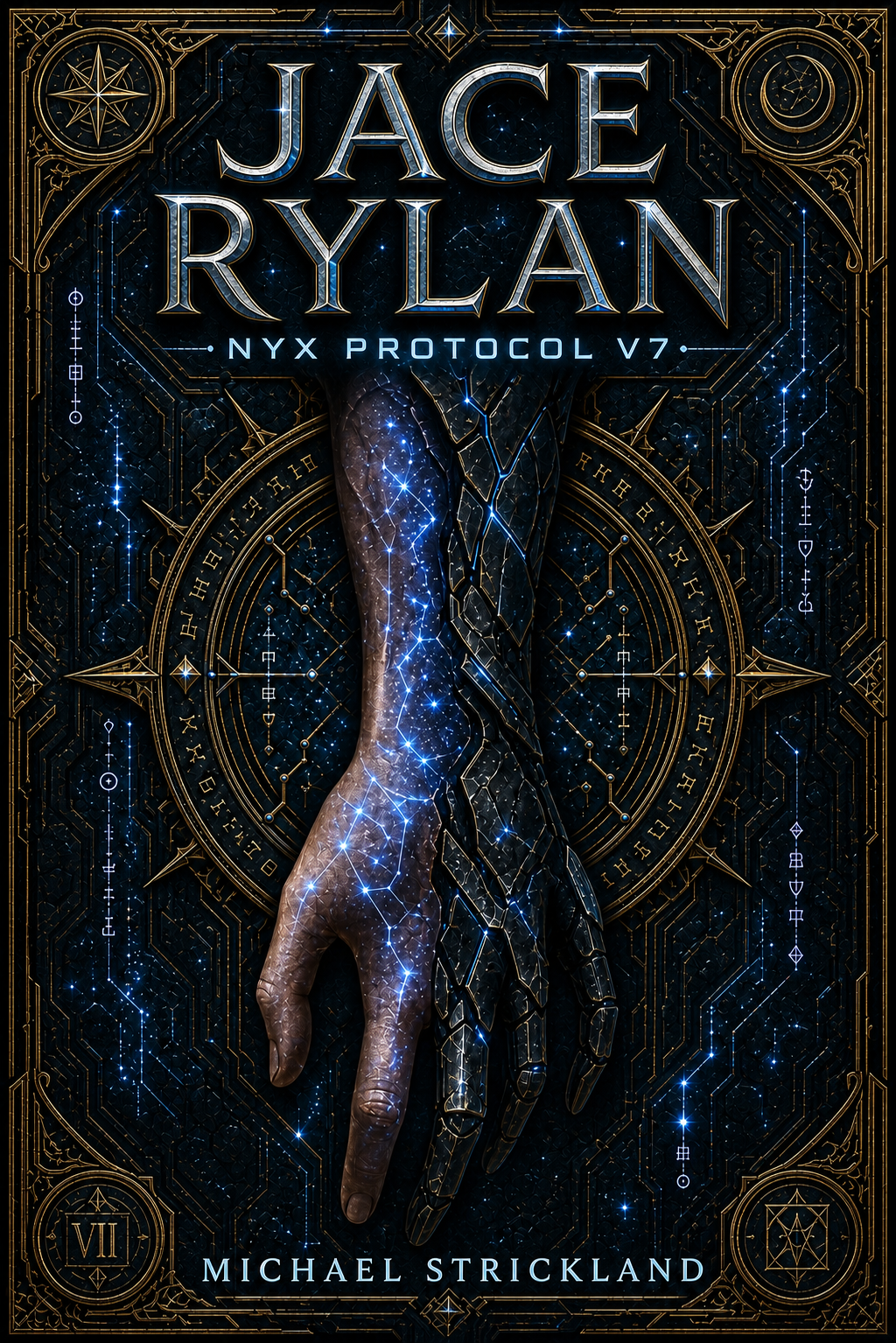
Level Up Book II — Jace Rylan — NYX Protocol V7
Release 2027
About the book
Jace Rylan knows how to survive the Commons. He is quick, funny, and observant, with a mouth that can ease a tense moment—and a body that starts mapping exits when danger comes too close.
Three years after Ascendant City burned, Jace wants more than another narrow escape. He wants to become someone who stands his ground when it matters. NYX Protocol V7 follows that struggle into a transformation he does not yet understand.
LOOK INSIDE
Begin the
reading experience.
Preview from the working manuscript. Text may change before publication.
Prelude — The Boy Who Wasn’t a Hero
It was 3055, three years after Ascendant City burned.
People still talked about that year in broken pieces.
The tower fires.
The blackout.
The fighting that spilled through stations and out toward the wasteland.
From the Commons, most of it had looked far away.
Too high above.
Too dangerous to understand.
Too big for people who still had to wake up the next morning and figure out how to pay for food.
The Commons had not burned.
That was the strange part.
The sky had changed.
The feeds had screamed.
People had crowded under public screens and watched smoke climb where glass towers used to shine clean and cold.
But down here, the streets stayed standing.
The Commons was still the Commons.
Crowded.
Loud.
Restless.
The pavement ran uneven under old shoes and cheap boots, patched from age instead of war, with long cracks filled by whatever the city could afford to stop the ground from splitting wider. Metal stairways rattled when people ran down them too fast. Vendors cooked over dented heat plates and shallow steel pans, sending the smell of grease, spice, and synth-meat into the morning air. Loose cables sagged between buildings. Old signs buzzed overhead, blinking blue, red, and gold across walls stained by years of smoke, rain, and human hands.
Nothing down there looked polished.
Everything looked used.
That was home.
Not beautiful.
Not safe.
Still home.
Jace Rylan knew how to move through it the way some people knew prayer.
He knew which market ramps dipped lower than they looked, which alleys collected floodwater when the drains backed up, which blocks belonged to crews that would press a man for credits just because he made eye contact too long. He knew how to pass through a crowd without brushing the wrong shoulder, how to keep his bag close, how to hear trouble in the change of a voice before the first shove ever landed.
He had ears for the city.
He could feel arguments building in the air by tone alone—voices tightening, steps shifting, metal rails picking up a different kind of vibration when someone started moving with intent instead of just fatigue. Even when he pretended not to be listening, his body heard every warning in the sound.
And most of all, Jace knew how to leave.
That was a talent in the Commons. Maybe not the kind anyone respected, but survival rarely cared about respect. Survival cared about timing. About reading the room. About understanding when a bad situation was only bad and when it was about to become the kind of problem that got your blood on the ground.
Jace understood that difference better than he wanted to.
What he did not understand was how to keep his mouth shut.
That had always been his real problem.
He had a wild sense of humor and a smart-ass mouth that jumped out before common sense had time to grab it by the collar. If a delivery drone clipped a sign and tumbled into a bin, Jace was the first one muttering, “Clean landing. Real professional work there.” If a public announcement froze halfway through some polished speech about order and recovery, he would tilt his head and say, “Looks fixed to me,” just low enough to make the nearest vendor choke on a laugh.
That was the thing about Jace.
He could make people laugh.
He could make a tense moment wobble.
He could turn one sharp line into five seconds of relief in a place that did not offer much of it.
Then somebody bigger would step forward.
And Jace would remember exactly who he was.
He was not the biggest man in any room.
He was not the strongest.
He was not the kind of person trouble looked at and decided to avoid.
He was quick.
Funny.
Observant.
Easy to like when fists were not involved.
But once anger got close enough to breathe on him, his body made decisions faster than his pride ever could. His shoulders tightened. His thoughts sped up. His mouth went dry. Somewhere inside him, a voice started mapping exits before the rest of him had fully accepted he was afraid.
Run.
Back off.
Apologize if needed.
Live long enough to be ashamed later.
He hated that last part the most.
Because fear was normal in the Commons. Fear kept people fed. Fear kept people alive. Fear taught kids not to reach into the wrong pile of scrap and taught grown men not to ask who really owned a block after dark.
But shame was quieter.
Shame waited until the room was empty.
Until the jokes ran out.
Until the smile fell off your face and you had to sit alone with the truth.
Jace knew that truth well.
He could name specific moments instead of pretending it was just “sometimes.”
The night on Fifth Strip when three men started beating a vendor for short payments and Jace stood behind a crate, making weak jokes in his head and letting his feet stay planted. The afternoon he saw a kid get shoved hard enough to spill food he couldn’t afford and still chose the far lane because the near one had too much heat in it. The day a crew man grabbed Jace’s own collar, pressed him against a wall, and he heard his own voice say, “My bad,” instead of anything that might have changed the outcome.
He’d watched those scenes like a ghost with a mouth—present enough to see everything, far enough away to leave without proof he’d been there.
Later, when the city noise dropped and the walls stopped vibrating, those were the reels that played.
He had heard stories, same as everybody else.
Stories about men who fought when they should have folded. Stories about people who looked at chaos and moved toward it instead of away from it. He did not know how much of any story was real. In the Commons, truth picked up extra pieces every time it changed hands. But even rumors carried weight when enough people repeated them.
Somewhere in the recent history of this same world, real people had stood their ground.
Not because they were fearless.
Because they chose not to run.
Jace admired that from far away.
That was easy to do.
Admiring courage cost nothing.
Owning it was expensive.
By the time evening rolled through the Commons and the hanging bulbs clicked on one by one, Jace could usually fake being lighter than he felt. He could grin. He could joke. He could lean on a stall and talk trash about glitched tech, broken scanners, cheap boots, bad music, bad cooking, bad weather, bad luck. People saw the mouth first. The humor. The easy energy.
They did not always see what sat underneath it.
The part of him that replayed old moments in private.
The part that remembered every time he backed down.
The part that wanted, more than he liked admitting, to be different when it counted.
Not famous.
Not unstoppable.
Just different.
Just once, he wanted to be the kind of man who did not leave somebody standing alone when the wrong people came near.
He could picture it in his head—a better version of himself who didn’t feel his feet angle toward exits at the first sharp noise, who stepped into the space between a fist and its target and didn’t immediately wonder how long it would take med drones to arrive if things went badly.
Wanting it had never been enough to change him.
Until the day Rax Eliron went too far.
On that day, when the wrong men stepped into the wrong street and Jace’s body tried to choose the same old exit, something in his mind finally snapped the other way.
He was still afraid.
He was still outmatched.
But for the first time in his life, he wanted to stand his ground more than he wanted to run.
He just didn’t know yet that wanting was about to cost him everything he thought he understood about himself.
END OF PRELUDE
KEEP EXPLORING